
How Miti Ruangkritya turns pollution into art.
Words: Atikom Mukdaprakorn
Photos: Courtesy of Miti Ruangkritya, Atikom Mukdaprakorn
The air in Chiang Rai fills with ashes in early February as window sills become lined with sediments. The sky brings with it a dark shade of blue mixed with yellow, creating a gradient of gray. All one can do is to close the windows and sweep up the ashes that nature has brought inside. Chiang Rai is just a few days away from seeing the annual two-month ban on open-air incineration: a period in which locals are familiar with, as they have—for more than a decade—watched the solid whiteness wipe out blue skies, taking with it picturesque views from the beautiful mountains that Chiang Rai is known for.
About a month earlier, back in mid-January, the Metaphorical Landscape exhibition presented by 9 artists at the Baan Tuek Art Center in Chiang Mai included an art piece made up of three items encased in a light gray frame: from afar they seem to be a product of powder paint spread all over. This art piece is hung on the wall and blends in perfectly, as if it were just a mark on the wall. Upon closer inspection, what looked almost like a mural emerges as a picture of a piece of Miti Ruangkritya’s collection. The three colours—red, blue, and black—are theme colours in this exhibition that presents views and geography to show that these powder paint colours are more than mere representations of store-bought art supplies.
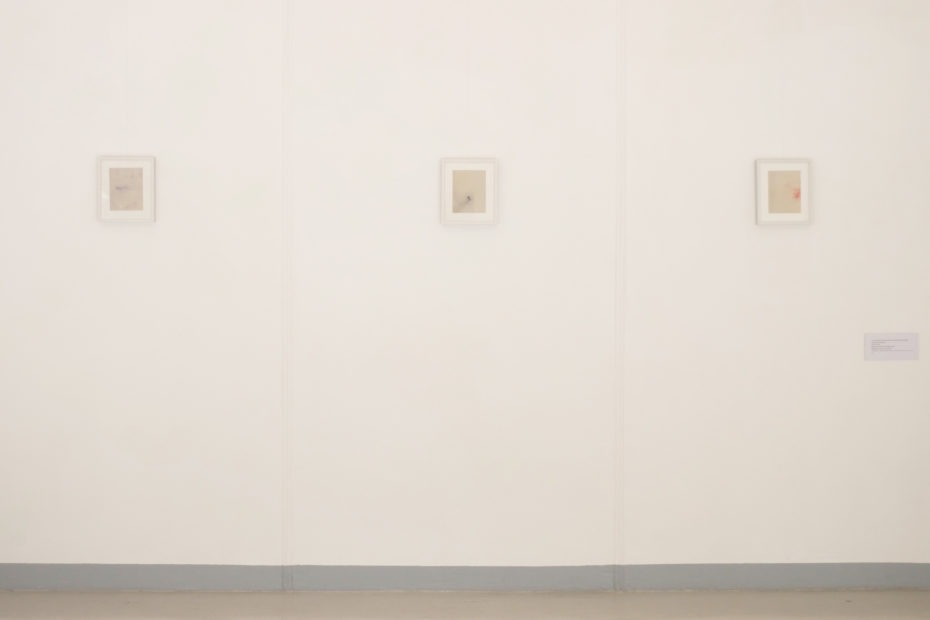
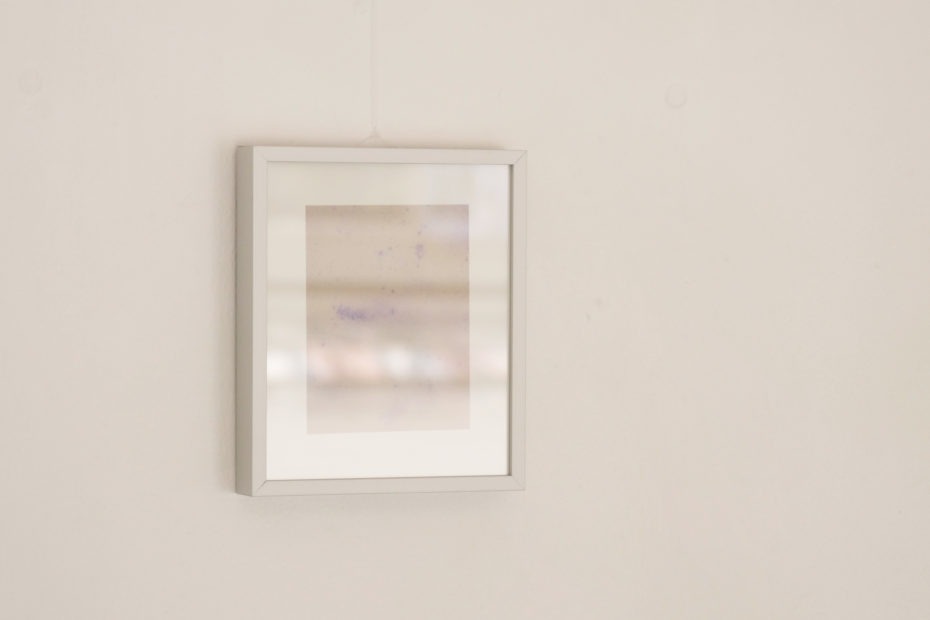
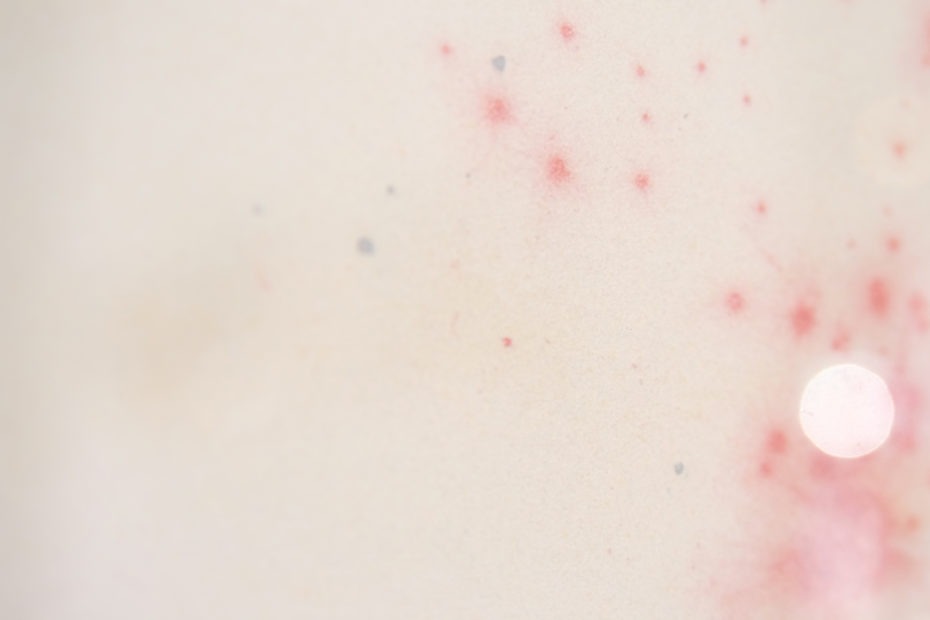
Miti Ruangkritya. Untitled from Coloured Dust and Metallic Particles, 2017 – 2018. “Metaphorical Landscape” the group exhibition at Baan Tuek Art Center, Chiang Mai Thailand; curated by Supapong Laodheerasiri. January 13 – 27, 2019. Photos by Atikom Mukdaprakorn, 2019.
Miti Ruangkritya is widely known for his photos from the great floods in 2011, real-life photos that ironically take viewers beyond the physical realm to a more dreamy space. Most people see Miti as a photographer, which is not altogether incorrect, as his background lies in putting recording real-life events on photographs. In his most recent solo exhibition “Dream Property” at the BANGKOK CITYCITY GALLERY in 2016, however, he proved to be more: in addition to photographs, Miti converted a one-square-metre-long block of soil taken from the grounds of an old school in Rajprasong district—soon to be demolished to make room for a condominium—into a piece of art. This conversion served as a representation of how land prices in Bangkok skyrocket. Both the photographs and his art pieces serve to show Thailand’s lost decade and require that viewers with a deep understanding of Thai society interpret meanings—only then will his art’s true beauty be revealed.
A lot of Miti’s pieces are centered around the lives of city dwellers, particularly those in Bangkok, his hometown. Miti watches and contemplates the changes that take place in Bangkok before he evolves a way to convey these observations through his art pieces. A recurring theme over the years for Miti is people’s sickness, particularly allergies, rising from the poor air quality. However, because that pollution was unclear to the naked eyes, Miti attempted to communicate its detrimental effects via his pictures of roads and of people being ill, as we often see on environmental news. He therefore took his art a step further beyond taking photos of people suffering due to environmental factors, as we usually see in other works.
In mid 2017, Miti was invited by the Arts Initiative Tokyo to be one of their Artist in Residence. He brought with him an art project that he had been developing: powder colour with weight. Carrying this to Japan in his luggage, Miti then took it up to a Shibuya skyscraper and let the wind blow these heavy powder colours down to papers he had laid out. Because the powders are heavier than regular paint powder, they could be blown down onto paper. This product became part of his “Coloured Dust and Metallic Particles” collection. Two years later, this artwork became part of the piece framed with light gray on the wall mentioned above. This plethora of dust approaches Chiangmai in the shape of white fog, coinciding with the panic brought on in Bangkok as residents experienced, for the first time, the wave of over pollution. People flocked to stock up on masks, avoiding natural air outside and even opting not to go running outdoors, and turning their attention to how air quality is measured.
The effect in Bangkok incited the press that were long crowded together in the city to analyze how much the dust had spread—in effect: to the whole country. On the day when Bangkok saw its worst pollution as measured by particulate matters—the level that day was PM2.5–the level in Khon Kaen was even higher. When the dust cleared a little in Bangkok, the AQI level in the middle of Chiang Mai went up so high to 215—a level coded with the colour purple—making Chiang Mai the city with the worst pollution on that particular day. It doesn’t stop there though, because the AQI level continued to rise throughout the months of February and March. Aside from Southern Thailand which is luckily in the middle of two oceans, and therefore has wind blowing in from both sides, there is no way to escape the dust. Unlike the great flood in Bangkok, in which people were able to seek refuge in other provinces.
Miti foresaw this pollution’s anatomy even before it blanketed all of Thailand. This wasn’t deduction merely based on prediction, but rather on observations of other large cities around the world: as cities went through war or as they rushed to leap into a more developed city through faster production in factories, the byproduct was pollution. One can almost view this philosophically: society changes and sheds it skin in order to form new buildings, factories, infrastructures, and inevitably: dust. It is an unintended product that is deemed extraneous, and because it is “extra,” people allow it to float aimlessly without purpose as they would the wind and water. We only choose to see dust when it becomes a problem to us.
A year before going to Tokyo, Miti was inspired to investigate the industrial estate areas surrounding Bangkok; he felt that the information he had previously gathered led him to such areas. These areas are populated with factories owned by foreign countries around the world. Miti looked into how industrial waste from these factories were delt with, large international brands had their products made in these areas, using resources from Thailand and turning them into products sold abroad. Waste and expired products would then be sent back to Thailand to be crushed and incinerated. These steps resulted in useless byproducts: all coming out from countries that have stepped past the white fog and into a new realm of development and into developing countries that will never step out into being developed.
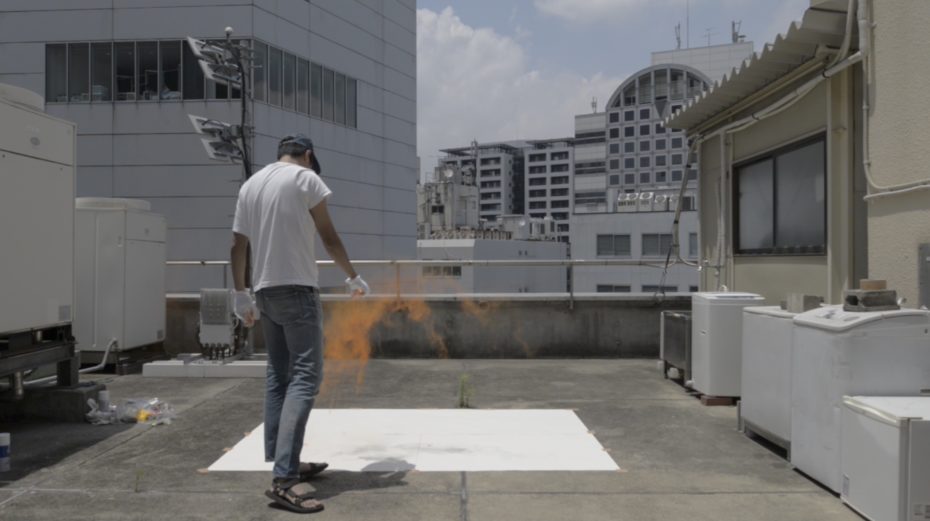
Ruangkritya spread heavy industrial waste in the air on a rooftop in Shibuya, Tokyo. Image courtesy of Miti Ruangkritya, 2017
Miti collected colourful dust particles that were part of the waste produced by these factories and transformed them into his main resource for producing art: he threw dust taken from the scraps of one entire car into the heart of Japan’s business district–the location in which these car were produced —and let the wind and fate blow such dust into its own direction. Some of them fell out into the open, while others fell onto the paper that he had laid out. He then sealed the dust onto paper, framed the piece, and displayed it in a nearby mall. He sold it as art: a turnaround process that took waste and turned it into a highly-prized product, crossing borders and bringing this waste back to its origin—the people who created and did not take responsibility for it—and making money from the people who benefit directly from such dust.
His method of production didn’t require much. In the exhibition space in Tokyo, beside the paper with the dust particles lies a piece of brick—not just a regular piece of brick, of course. The brick’s edge is dented as it has been banged up, with the residue dust piled next to it. Miti had taken this brick from the industrial estate, where certain factories showed their social responsibility by having small dust waste made into these bricks by local people who lived in the area. Though this process helps reduce dust waste by turning a portion of them into usable bricks, the neglected dust waste were distributed into open air, floating around into the heart of Bangkok and leading to extremely detrimental health issues for residents.
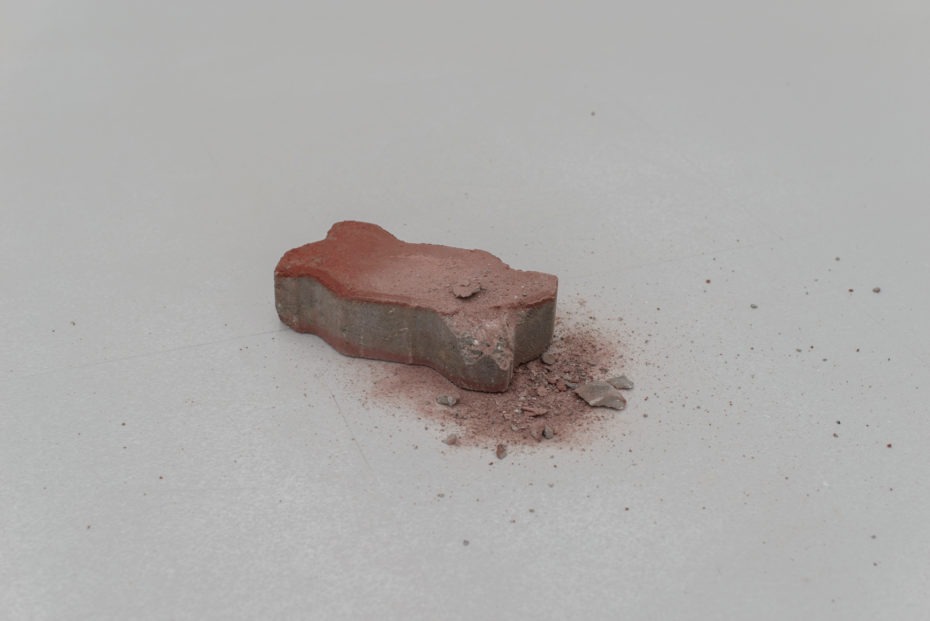
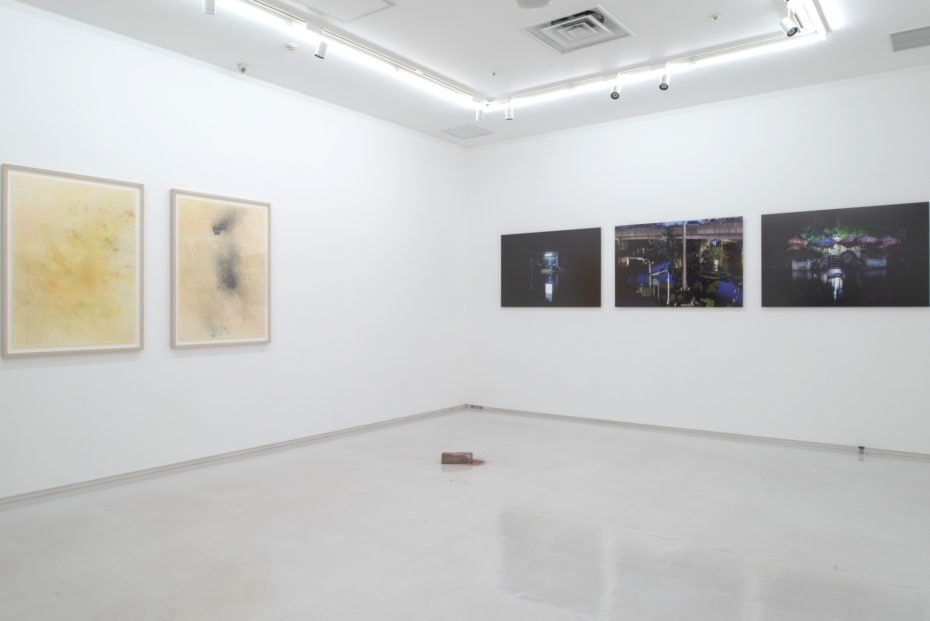
Miti Ruangkritya. Coloured Dust and Metallic Particles, 2017. The BAR Vol.10 Exhibition “Shaping Voices, Silent Skies” the exhibition at 8/ ART GALLERY/ Tomio Koyama Gallery, Tokyo, Japan. July 1 – 17, 2017. Image courtesy of Miti Ruangkritya, 2017
Back in Chiang Rai where much credit has been given for its proper handling of waste incineration, despite lack of such proper waste treatment in other areas of Thailand. A view from satellites shows that there are “hotspots” showing up in red in China, Myanmar, Laos, and Cambodia, but there are no red spots in Chiang Rai: here, people are banned from incinerating waste from agricultural production and forest fires are strictly prohibited. These bans which required much collaboration among local authorities over several years have proven effective. Even during Songkran Seasons in April every year, when there is no wind, there is less dust fog here than in other provinces. This doesn’t make Chiang Rai completely dust-free, because dust from surrounding areas still manage to make its way into the area.
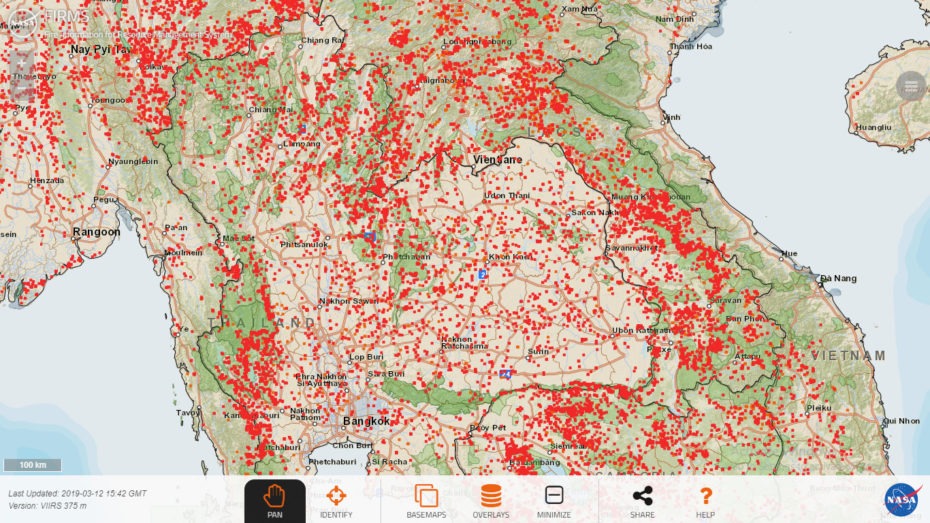
FIRMS – Fire Information for Resource Management System (https://firms.modaps.eosdis.nasa.gov — captured on March 13, 2019)
This is because air doesn’t remain stagnant in one place, it floats across provinces and across international borders. The problem of these seasonal fogs spans across the continent: Indochina countries are all dealing with lack of government control. The area is embattled with forest fires and effects from El Nino, but the response has been slow. In fact, it almost seems as if those in charge are waiting for the situation to quieten, as it had in years past.
“The less democratic a country is, the more difficult it is to reduce the problem of smog,” says Miti. This observation came from how China has long had a problem with pollution. Our partners in Indochina seem to face the same situation as we do now, as a non-democratic state need not take care of their people. Merely by facilitating capitalists to increase profits and sharing the wealth among elites can improve a country’s GDP. But to grow as a country, one can not only look to economic standings. It’s also important to consider the the environment and reducing social inequality. Such factors need to be calculated into production costs if we want things to be considered fair and just. Otherwise, a country can never step out of the haze of its past. A few bits of dust, hand-picked and scattered on paper from Miti has drawn lines that unite those between countries, between those who should be responsible, and between those affected.
Find out more at www.mi-ti.com and www.facebook.com/oneonec
มิติ เรืองกฤตยา กับการเปลี่ยนมลสารเป็นงานศิลปะ
Words: Atikom Mukdaprakorn
Photos: Courtesy of Miti Ruangkritya, Atikom Mukdaprakorn
เชียงราย ต้นเดือนกุมภาพันธ์ เศษขี้เถ้าลอยมาตกลงบนขอบหน้าต่าง มองออกไปเห็นท้องฟ้าสีฟ้าเข้มไล่เฉดลงมาเป็นสีเหลืองขมุกขมัวอยู่ตรงขอบฟ้า เราทำอะไรไม่ได้นอกจากปิดหน้าต่างแล้วปัดกวาดเศษเถ้าเหล่านั้น อีกไม่กี่วันมาตรการห้ามเผาสองเดือนประจำหน้าแล้งของปีก็จะเริ่มต้นแล้ว ช่วงเวลาที่คนในภาคเหนือรู้กันว่าต้องทำอย่างไรบ้าง ก่อนที่สีของท้องฟ้าจะกลายเป็นฝ้าขาวทึบจนลบดอยหายไปเช่นที่เคยเป็นมาตลอดสิบกว่าปี
ย้อนกลับไปเล็กน้อย ราวกลางเดือนมกราคม ในนิทรรศการ “ทิวทัศน์อุปมา” (Metaphorical Landscape) ของศิลปิน 9 คน ซึ่งจัดแสดงที่ศูนย์ศิลปะบ้านตึก เชียงใหม่ ผลงานขนาดเล็กชุดหนึ่งในกรอบสีเทาอ่อน 3 ชิ้น ที่ดูเผินๆ จะนึกว่าเป็นงานจิตรกรรมจากการสาดสีฝุ่นเป็นรอยด่างดวง มันติดตั้งอย่างเรียบเฉยจนแทบจะกลืนหายกลายเป็นเพียงรอยเปื้อนอยู่บนผนัง งานชุดนี้แท้จริงแล้วเป็นภาพสำเนาจากบางส่วนของผลงานโดย มิติ เรืองกฤตยา ฝุ่นสามสี แดง น้ำเงิน และดำ ในแต่ละภาพ ได้มาปรากฏอยู่ในนิทรรศการของศิลปะที่ว่าด้วยแนวคิดเรื่องทิวทัศน์และที่มีนัยยะทางภูมิศาสตร์ มันบอกใบ้ถึงสถานะของผงสีเหล่านี้ว่ามีความเกี่ยวข้องไปไกลเกินกว่าจะมาจากร้านอุปกรณ์ศิลปะ
Miti Ruangkritya. Untitled from Coloured Dust and Metallic Particles, 2017 – 2018. “Metaphorical Landscape” the group exhibition at Baan Tuek Art Center, Chiang Mai Thailand; curated by Supapong Laodheerasiri. January 13 – 27, 2019. Photos by Atikom Mukdaprakorn, 2019.
มิติ เรืองกฤตยา เป็นที่รู้จักอย่างกว้างขวางจากผลงานภาพถ่ายที่ดูเหนือจริงและชวนฝันของเหตุการณ์น้ำท่วมใหญ่ปี 2554 ทำให้หลายคนคิดว่าเขาเป็นช่างภาพ ซึ่งก็ไม่ผิดเท่าไหร่นัก ด้วยพื้นฐานการทำงานของเขาคือการบันทึกความจริงที่เกิดขึ้นออกมาเป็นภาพ แต่อย่างในนิทรรศการเดี่ยวครั้งล่าสุดในประเทศไทยของเขา “Dream Property” (2559) ที่ BANGKOK CITYCITY GALLERY นอกจากงานส่วนใหญ่ที่เป็นภาพถ่ายแล้ว เขายังได้ตัดเอาแปลงดินขนาดหนึ่งตารางเมตรจากที่ดินโรงเรียนเก่าย่านราชประสงค์ที่กำลังจะกลายเป็นคอนโดมิเนียมมาแสดงด้วย ดินแปลงนั้นเป็นเสมือนบันทึกการถีบตัวขึ้นอย่างรวดเร็วของราคาที่ดินในกรุงเทพฯ ระหว่างทศวรรษที่สูญหายของประเทศไทย ทั้งแปลงดินและภาพถ่ายของเขา ไม่ได้เป็นศิลปะเพื่อการมอง แต่เป็นศิลปะที่ต้องคิดอ่านผ่านความเข้าใจทางสังคม แล้วความงามในเนื้อหาที่แท้จริงจึงจะเผยตัวออกมาให้เห็น
ผลงานที่ผ่านมาของมิติหลายชุดเกี่ยวข้องกับความเป็นผู้อยู่อาศัยในเมือง โดยเฉพาะเมืองกรุงเทพฯ ที่เป็นบ้านของเขา เขาเฝ้าติดตามความเปลี่ยนแปลงต่างๆ ของเมืองนี้และครุ่นคิดต่อมันอยู่เสมอ ก่อนจะหาทางบันทึกผลของความเปลี่ยนแปลงเหล่านั้นออกมาเป็นงานศิลปะ อย่างไรก็ดี เรื่องหนึ่งที่ติดขัดในใจของเขาแต่หาทางบันทึกเป็นภาพไม่ได้มาหลายปี ก็คือความเจ็บป่วยเรื้อรังตลอดปีของคนในเมืองนี้ที่มีอาการภูมิแพ้กำเริบหนักขึ้นเรื่อยๆ จากความไม่ปกติของอากาศ แต่ในเวลานั้นอากาศยังเป็นอากาศที่ตาเปล่ายังมองไม่เห็น เขาจึงเริ่มทำการบางอย่างที่ไปไกลกว่าการถ่ายถนนหนทางหรืออาการเจ็บป่วยของผู้คนไว้อย่างที่เราเห็นกันในงานข่าวสิ่งแวดล้อมกันบ่อยๆ
โตเกียว กลางปี พ.ศ. 2560 มิติ ได้รับเชิญจาก Arts Initiative Tokyo ไปเป็นศิลปินในพำนัก เขาได้นำงานที่พัฒนามาก่อนหน้านั้นติดมือไปด้วย มันคือผงสีที่มีน้ำหนักไม่ปกติจำนวนหนึ่งที่เขาพกขึ้นเครื่องบินเดินทางไปสู่ประเทศญี่ปุ่น แล้วโปรยให้สายลมบนดาดฟ้าของตึกสูงกลางย่านชิบุยะพัดพาไปตกบนกระดาษเป็นผลงานชุด “Coloured Dust and Metallic Particles” งานชุดนี้คือต้นแบบที่กลายกลับมาเป็นรูปในกรอบสีเทาอ่อนที่เชียงใหม่ในอีก 2 ปีถัดมา เพียงไม่กี่วันก่อนที่หมอกควันประจำปีของภาคเหนือจะมาเยือน และเป็นปีแรกที่คนกรุงเทพฯ ได้ตื่นตระหนกกับภาพของหมอกควันหนาทึบที่แผ่คลุมทั้งเมือง ทำให้หลายคนวิตกกังวลต่อการออกไปวิ่งกลางแจ้ง คนแห่ซื้อหน้ากากกันฝุ่นและเครื่องฟอกอากาศกันจนขาดตลาด ทั้งยังต้องทำความรู้จักกับมาตรฐานการประเมินสภาพอากาศที่ไม่เคยใส่ใจกันมาก่อนเป็นการด่วน
ผลกระทบต่อกรุงเทพฯ ปลุกสื่อมวลชนระดับประเทศที่กระจุกตัวอยู่ที่นั่นให้เริ่มตื่นตัวกับมลสารในอากาศและเพิ่งหันมามองเห็นภาพรวมของหมอกควันซึ่งได้ท่วมทะลักไปแทบจะทั้งประเทศแล้ว วันที่หมอกควันหนาทึบที่สุดในกรุงเทพฯ ปริมาณ pm 2.5 ที่ขอนแก่นกลับพุ่งขึ้นสูงยิ่งกว่า และหลังจากหมอกควันกรุงเทพฯ เริ่มเบาบางลง ค่าดัชนี AQI ที่กลางเมืองเชียงใหม่ก็แซงทุกที่ขึ้นไปถึงขีดสีม่วงที่ 215 เป็นเมืองอากาศแย่ที่สุดในโลกในวันนั้น และยังขยับขึ้นไปเรื่อยๆ ตลอดเดือนกุมภาพันธ์และมีนาคม นอกจากภาคใต้ที่ได้ลมทะเลทั้งสองฝั่งแล้ว ทั่วประเทศไทยก็ไม่มีที่ไหนให้เราหลบหนีควันไปได้อย่างที่คนภาคกลางเคยหนีไปอยู่ตามภาคอื่นๆ ชั่วคราว เมื่อครั้งน้ำท่วมใหญ่ปี 2554
มิติ มองเห็นกายวิภาคของหมอกควันเหล่านี้ตั้งแต่ก่อนที่มันจะครอบคลุมไปทั้งประเทศไทย เขาทำการสำรวจประวัติศาสตร์และพบว่าปรากฏการณ์นี้เคยเกิดขึ้นมาแล้วในเมืองใหญ่ทั่วโลก ไม่ว่าจะในยุคสมัยแห่งสงครามใหญ่หรือในช่วงเวลาที่อุตสาหกรรมหนักกำลังเร่งให้เมืองเหล่านี้พัฒนาไปได้อย่างก้าวกระโดด กล่าวคือ เมื่อสังคมหนึ่งกำลังจะเปลี่ยนผ่านเข้าสู่สภาวะสมัยใหม่ ต่างก็ต้องสร้างสิ่งใหม่ขึ้นมามากมาย โรงงานใหม่ อาคารใหม่ การคมนาคมใหม่ และต่างก็หนีไม่พ้นการผลิตฝุ่น ฝุ่นเป็นสิ่งที่ได้มาพร้อมกับการผลิตที่เราไม่เคยนับมันเป็นผลผลิต และเมื่อเป็นส่วนเกิน มันจึงถูกปล่อยปละให้ลอยละล่องไปตามยถากรรม กับน้ำ กับลม มันจะกลับมาอยู่ในสายตาของเราอีกครั้งเมื่อฝุ่นมีมากจนเป็นปัญหากับเรา
หนึ่งปีก่อนมิติจะไปโตเกียว ข้อมูลต่างๆ ได้พาเขาออกไปสำรวจนิคมอุตสาหกรรมใกล้ๆ กรุงเทพฯ ที่เต็มไปด้วยโรงงานอุตสาหกรรมหนักจากนานาชาติ รวมทั้งยังได้ไปสำรวจการกำจัดขยะอุตสาหกรรมด้วย สินค้าแบรนด์ใหญ่ระดับโลกถูกนำมาผลิตด้วยทรัพยากรในไทย ส่งกลับไปขายในต่างประเทศ แล้วเศษซากของสินค้าที่หมดอายุขัยแล้วก็จะวนกลับมาที่ไทยอีกครั้ง เพื่อทำการกำจัดด้วยการบดจนเป็นผุยผงและเผาทำลาย ทุกขั้นตอนอันจะก่อให้เกิดส่วนเกินการผลิตที่ไม่มีใครเห็นประโยชน์ ล้วนถูกส่งออกมาจากประเทศที่ก้าวพ้นหมอกควันแห่งการพัฒนาไปเป็นประเทศสมัยใหม่ได้แล้ว มาเทรวมไว้ในประเทศกำลังพัฒนาที่ไม่เคยพัฒนาจนแล้วเสร็จเสียที
Ruangkritya spread heavy industrial waste in the air on a rooftop in Shibuya, Tokyo. Image courtesy of Miti Ruangkritya, 2017
มิติ ได้เก็บรวบรวมฝุ่นผงสีสันสะดุดตาจากโรงงานเหล่านี้เอาไว้ แล้วทำการสลับเอากระบวนการกำจัดมาใช้เป็นขั้นตอนการผลิต ด้วยการปล่อยโปรยฝุ่นผงที่ย่อยมาจากรถยนต์ทั้งคันตรงกลางย่านธุรกิจใหญ่ซึ่งเป็นที่ที่ทุนทำงานอย่างเข้มข้นที่สุดในประเทศของเจ้าของบริษัทรถยนต์ ให้ลมธรรมชาติได้พัดพามันไปตามยถากรรม บ้างก็ฟุ้งกระจายหายไป บ้างก็ตกแตะผืนกระดาษที่เขาวางรองไว้ เขาเคลือบผนึกฝุ่นบนกระดาษ แล้วนำลงมาจากดาดฟ้าไปใส่กรอบจัดแสดงที่แกลเลอรี่ในห้างใกล้ๆ กันนั้น เพื่อขายมันในฐานะของงานศิลปะ กระบวนการตลบหน้ากลับหลังนี้ได้นำเอาสิ่งที่ไม่ถูกนับว่าเป็นผลผลิตกลับมาสร้างเป็นผลิตภัณฑ์ในธุรกิจมูลค่าสูง ย้อนเส้นทางเดิมของทุนข้ามชาติกลับไปขูดเอากำไรจากผู้ก่อให้เกิดฝุ่นผงเหล่านี้
วิธีการทำงานครั้งนี้ของมิติไม่ใช่อะไรอื่นไกล ในห้องนิทรรศการที่โตเกียวนั้น นอกจากกระดาษประทับรอยยถากรรมของฝุ่นสีที่แขวนโชว์ไว้แล้ว ก็ยังมีอิฐปูถนนหนึ่งก้อนที่ขอบมุมของมันถูกทุบแตกเป็นผุยผงกองอยู่ด้วย มิติได้อิฐก้อนนี้มาจากนิคมอุตสาหกรรมในประเทศไทย มันเป็นผลิตภัณฑ์เพื่อแสดงความรับผิดชอบต่อสังคมที่บางโรงงานได้นำฝุ่นผงตกค้างจากการกำจัดของเสียมาให้ชาวบ้านอัดแท่งขึ้นรูปเป็นอิฐไปใช้กัน กลไกของทุนนี้ดำเนินไปอย่างแนบเนียนจนสามารถเปลี่ยนกระบวนการกำจัดให้กลายเป็นมูลค่าเพิ่มให้กับนายทุนได้อีกครั้ง ส่วนฝุ่นผงส่วนที่เหลือ ก็ไม่ได้รับการใส่ใจที่จะพิสูจน์ว่ามีผลกระทบทางสิ่งแวดล้อมเป็นส่วนหนึ่งของหมอกควันแผ่ไปถึงกรุงเทพฯ ที่ทำให้บางคนถึงกับมีมูกเลือดในจมูกหรือไม่
Miti Ruangkritya. Coloured Dust and Metallic Particles, 2017. The BAR Vol.10 Exhibition “Shaping Voices, Silent Skies” the exhibition at 8/ ART GALLERY/ Tomio Koyama Gallery, Tokyo, Japan. July 1 – 17, 2017. Image courtesy of Miti Ruangkritya, 2017
กลับมาที่เชียงราย ปีนี้ได้รับการกล่าวขวัญเป็นอย่างมากท่ามกลางความตื่นตัวเรื่องหมอกควันทั่วประเทศ ว่าเป็นจังหวัดที่ควบคุมการเผาได้อย่างสมบูรณ์แบบ เมื่อส่องจากดาวเทียมตรวจตราจุดร้อน (hotspots) จะพบว่าท่ามกลางจุดสีแดงที่แผ่กระจายอย่างหนาแน่นตั้งแต่จีน พม่า ไทย ลาว ไปจนถึงกัมพูชา ในเส้นรอบรูปจังหวัดเชียงรายนั้นแทบไม่มีจุดร้อนอยู่เลย จังหวัดเชียงรายดำเนินมาตรการห้ามเผาเศษเหลือจากการเกษตรและดับไฟป่าแบบถึงลูกถึงคนมาอย่างต่อเนื่องหลายปีจนมีประสิทธิภาพในการประสานงานและจัดการ ตลอดสองเดือนก่อนสงกรานต์ที่เป็นช่วงอับลมของภาคเหนือ ที่นี่จึงมีควันในเมืองเบาบางกว่าจังหวัดอื่น แต่ก็ไม่ได้หมายความว่าอากาศจะสะอาดปลอดภัย ควันจากรอบด้านก็ยังแบ่งปันมาถึงอยู่ดี
FIRMS – Fire Information for Resource Management System (https://firms.modaps.eosdis.nasa.gov — captured on March 13, 2019)
อากาศไม่ได้หยุดอยู่กับที่ตามพิกัดพรมแดนจังหวัดหรือประเทศ แต่เชื่อมถึงกันไปหมด ปัญหาหมอกควันประจำฤดูขณะนี้เป็นปัญหาระดับภูมิภาคอินโดจีนที่เกิดขึ้นจากทั้งความเหลาะแหละในการควบคุมมลพิษจากอุตสาหกรรม และไฟป่าที่เป็นผลกระทบจากปรากฏการณ์เอลนีโญ หรือจากสาเหตุอื่นๆ นอกเหนือจากนี้ซึ่งยังไม่เคยมีการศึกษาวิจัยให้ระบุได้ชัดเจน การจัดการที่ดีในเฉพาะบางท้องถิ่นจึงไม่สามารถแก้ไขอะไรได้ ด้วยยังต้องการความร่วมมือที่กว้างขวางไปถึงระดับนานาประเทศ แต่รัฐในแถบนี้กลับดูจะไม่ใส่ใจและพยายามนิ่งเงียบ คล้ายว่ารอให้ความสนใจของผู้คนและสื่อมวลชนหายไปเองตามฤดูกาลดังที่เคยเป็นมาตลอดหลายปี
“ยิ่งประเทศไม่เป็นประชาธิปไตยเท่าไหร่ ปัญหาหมอกควันก็ยิ่งหนักขึ้นเท่านั้น” เป็นข้อสังเกตหนึ่งที่มิติพบจากการติดตามศึกษาเรื่องฝุ่น เรามองไปยังจีนที่มีปัญหาอากาศมานานแล้ว และเพื่อนร่วมควันในอินโดจีนของเราในขณะนี้ ต่างก็ไม่ได้เป็นประเทศประชาธิปไตยกันจริงๆ รัฐที่ไม่ได้ยึดโยงกับประชาชนนั้นไม่มีความจำเป็นอันใดที่จะต้องดูแลประชาชน แค่เอื้อให้นายทุนสร้างกำไรสูงสุดอย่างเต็มที่แล้วปันผลกันในหมู่ชนชั้นนำก็ทำให้ GDP ขยับสูงขึ้นได้ แม้ว่าคนส่วนใหญ่ในประเทศจะยังต้องกระเสือกกระสนดิ้นรนให้มีชีวิตรอดไปวันๆ ก็ตาม การก้าวไปสู่การเป็นประเทศสมัยใหม่จึงไม่น่าจะวัดกันได้จากเพียงแค่ความเติบโตทางเศรษฐกิจ แต่ยังต้องลดความเหลื่อมล้ำทางสังคมด้วย เพื่อให้ความยุติธรรมกับทุกคน ทำการนับรวมคุณภาพชีวิตและสิ่งแวดล้อมเข้ามาเป็นต้นทุนการผลิตที่ต้องดูแล และกระจายความสามารถในการจัดการทรัพยากรให้ทุกท้องถิ่น ไม่เช่นนั้น ประเทศนั้นก็ไม่อาจก้าวพ้นหมอกควันแห่งการพัฒนาออกไปได้
ฝุ่นผงไม่กี่หยิบมือที่ มิติ โปรยปรายลงบนกระดาษ ได้วาดเส้นโยงใยความสัมพันธ์ที่ยังไม่ทันมีใครมองเห็น ระหว่างประเทศ ระหว่างกระบวนการสร้างมลภาวะ ระหว่างผู้ที่ควรจะต้องรับผิดชอบ ระหว่างผู้ได้รับผลกระทบ จนภาพของหมอกควันปรากฏตัวขึ้นมาได้ ตั้งแต่มันยังไม่ทันจะปรากฏให้เห็นด้วยสายตา
ติดตามผลงานของมิติได้ที่ www.mi-ti.com และ www.facebook.com/oneonec
